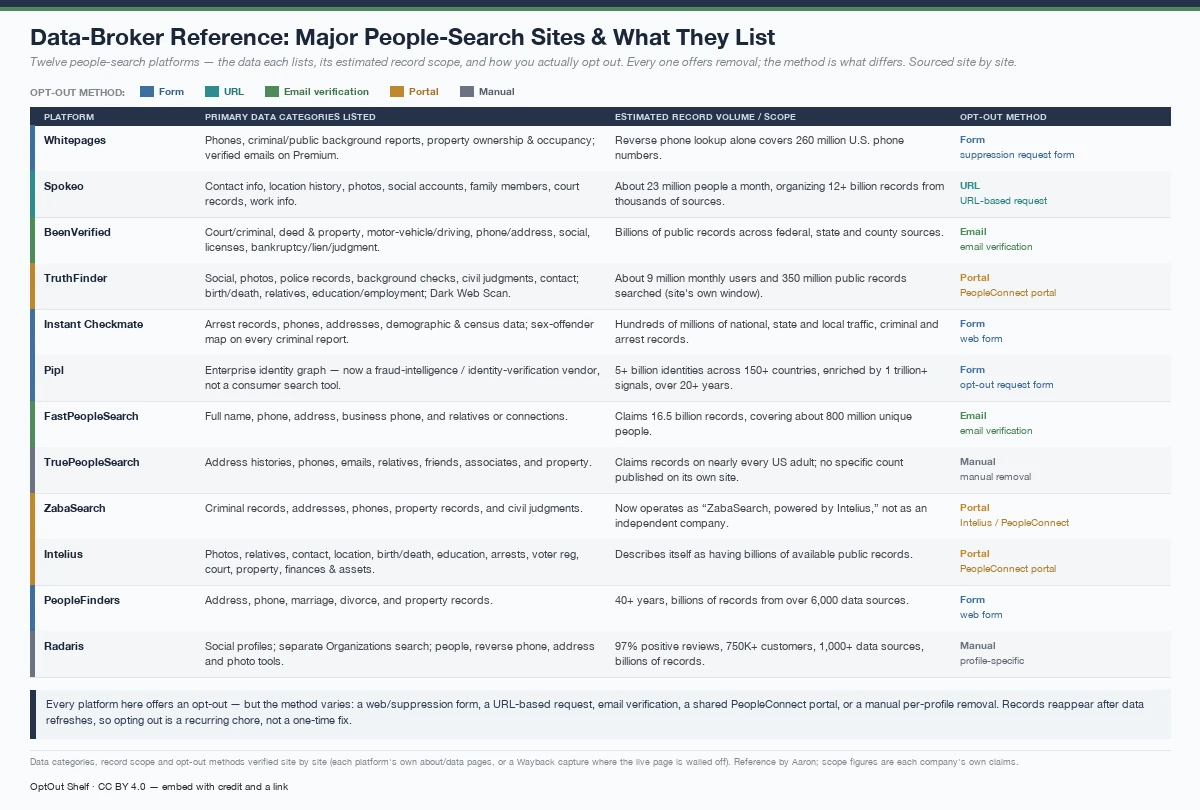
Major People-Search Sites and Data Categories
The table below is what each platform's own current site says it collects and how big it claims to be — not marketing copy filtered through somebody else's summary. Where a site didn't publish a number I could verify, I left the description qualitative instead of making one up.
| Platform | Primary Data Categories Listed | Estimated Record Volume / Scope | Opt-Out Availability |
|---|---|---|---|
| Whitepages | Phone numbers, criminal/public background reports, and property ownership & occupancy data [1], plus verified email addresses on paid Premium plans [2]. | Reverse phone lookup alone covers 260 million U.S. phone numbers [3]. | Yes (suppression request form) |
| Spokeo | Contact info, location history, photos, social media accounts, family members, court records, and work information [4]. | Serves about 23 million people a month, organizing over 12 billion records from thousands of sources [4]. | Yes (URL-based request) |
| BeenVerified | Court/criminal records, deed & property records, motor vehicle and driving records, phone/address directories, social media profiles, professional license records, and bankruptcy/lien/judgment records [5]. | Draws from billions of public records across federal, state, and county sources [6]. | Yes (email verification) |
| TruthFinder | Social media, photos, police records, background checks, civil judgments, and contact information [7], plus birth/death records, possible relatives, education and employment history [7], and a separate Dark Web Scan product [7]. | Averages about 9 million monthly users and 350 million public records searched, per the site's own stated measurement window [8]. | Yes (PeopleConnect portal) |
| Instant Checkmate | Arrest records, phone numbers, addresses, demographic data, and census data [9], plus a registered-sex-offender map included on every criminal report [9]. | Its records search scours hundreds of millions of national, state, and local traffic, criminal, and arrest records [9]. | Yes (web form) |
| Pipl | Enterprise identity graph of 5+ billion unique identities resolved from 1 trillion diverse signals [10]. Now positioned as an enterprise fraud-intelligence and identity-verification vendor rather than a consumer people-search tool. | Identity graph spans 5+ billion identities across 150+ countries, enriched by 1 trillion+ payment-fraud signals, built over 20+ years [10]. | Yes (opt-out request form) |
| FastPeopleSearch | Full name, phone number, address, business phone number, and relatives or connections [11]. | Claims 16.5 billion records available, covering about 800 million unique people [11]. | Yes (email verification) |
| TruePeopleSearch | Address histories, phone numbers, email addresses, relatives, friends, associates, and property information [12]. | Says it holds updated records on nearly every adult in the US, but doesn't publish a specific record count anywhere on its own site [12]. | Yes (manual removal) |
| ZabaSearch | Criminal records, addresses, phone numbers, property records, and civil judgments [13]. | Now operates as "ZabaSearch, powered by Intelius," rather than as an independent company [13]. | Yes (Intelius/PeopleConnect) |
| Intelius | Photos, possible relatives, contact info, location history, birth/death records, education history, arrest records, voter registration, court records, property records, and finances & assets [14]. | Describes itself as having billions of available public records [15]. | Yes (PeopleConnect portal) |
| PeopleFinders | Address search, phone search, marriage records, divorce records, and property records [16]. | One of the most expansive repositories of public records, spanning 40+ years with billions of records from over 6,000 data sources [16]. | Yes (web form) |
| Radaris | Social media profiles [17], plus a separate Organizations search for business and professional backgrounds [17], on top of its people, reverse phone, address, and photo search tools. | Reports 97% positive reviews, 750K+ satisfied customers, 1,000+ data sources, and billions of records [17]. | Yes (profile-specific) |
What eighteen months of doing this manually taught me
A few things didn't fit neatly into the table above but matter more than the table does, honestly. Whitepages is the one I'd watch closest if you're re-checking your own listings — it's the fastest re-lister on this page in my own tracking, and its opt-out form (the same one linked in the table) doesn't seem to stick the way the others do. Spokeo's opt-out is URL-based, which sounds convenient until you realize it means keeping a saved link for every listing you've ever removed — I lost track of mine within a month and had to re-search myself from scratch.
I also tried RoboForm's broker-monitoring add-on for about four months and canceled it. It would tell me a listing existed and then hand me the exact same manual opt-out form I could've found myself by searching the site name — for an extra monthly fee on top of the password manager subscription. If a tool only finds the listing and doesn't touch the removal, I don't see what I'm paying for. Contrast that with the paid full-service options (DeleteMe, Incogni), which at least file the requests for you — still worth checking their own re-listing rates before you assume "paid" means "solved," but that's a different article.
One more thing worth saying plainly: Pipl doesn't really belong on a "which people-search site turned up my address" list anymore. It's rebuilt itself into a fraud-and-identity-verification product sold to other businesses, not something an ordinary person searches by name — I'm keeping it here because its opt-out form still exists and some readers will have old profiles sitting in its index, not because it's a search engine you'd use to look someone up.
Data Category Definitions
A short glossary for the terms above — I had to look up a couple of these myself the first time I ran into them on an opt-out form.
- Public Records
- Information a governmental body is required to maintain and make accessible to the public [18].
- Identity Resolution
- The process an identity-resolution engine uses to find already-public pieces of personal information about someone and combine them into a single profile [19].
- Reverse Lookup
- A search that starts with a phone number instead of a name, to find the person or business it belongs to [11].
- Opt-Out / Suppression
- The process of asking a data broker to take your personal listing off its public search results [20].
Sources
- Whitepages: About Whitepages
- Whitepages: Premium Plans
- Whitepages: Reverse Phone Lookup
- Spokeo: About Us
- BeenVerified: Our Data
- BeenVerified: About Us
- TruthFinder: Homepage
- TruthFinder: About Us
- Instant Checkmate: About
- Pipl: Homepage
- FastPeopleSearch: About Us (Wayback Machine, 2026-05-18 -- live site returns HTTP 403 to automated requests)
- TruePeopleSearch: Homepage (Wayback Machine, 2026-07-10 -- live site returns HTTP 403 to automated requests)
- ZabaSearch: About Us
- Intelius: Homepage
- Intelius: Public Records Search
- PeopleFinders: Company Info (Wayback Machine, 2026-06-24 -- live site returns HTTP 403 to automated requests)
- Radaris: About
- Cornell Law School LII: "public record" (Wex)
- Pipl: My Information and Privacy
- Whitepages: Consumer Privacy Rights